The only scanner
with AI inside
the wand itself.
The only intraoral scanner with onboard diagnostic AI — caries, calculus, and periodontal findings executed inside the handpiece. No cloud. No latency. No dependency.
Every dental AI diagnostic system today
runs outside the wand. Noeikon™ doesn't.
Current Approach — External Inference
Noeikon — Onboard Inference
Four layers. One wand.
The Noeikon architecture integrates imaging, inference, attestation, and interoperability into a single instrument — collapsing a four-system stack into a handheld device.
Imaging Array
Multi-spectral optical sensor array capturing surface and near-surface intraoral data across visible and near-infrared spectra.
Onboard NPU
The only intraoral scanner executing diagnostic AI onboard the handpiece — caries, calculus, periodontal findings, no external compute required.
PUF Signing
Physically unclonable function element anchors every finding to the specific device that produced it via ECDSA-P256 cryptographic signature.
PMS Integration
Structured finding output in HL7 FHIR and native PMS formats — Dentrix, Eaglesoft, Curve Dental, Open Dental, and others.
Numbers that matter at chairside.
Finding latency from acquisition completion to chairside display — faster than any cloud-dependent architecture.
Patient image data never leaves the wand. HIPAA exposure eliminated at the architectural level.
Full diagnostic functionality with no network connection — rural clinics, mobile units, military field dentistry.
Every finding is signed
where it's born.
The Noeikon attestation layer generates a tamper-evident, PUF-anchored cryptographic record at the moment of acquisition — creating a verifiable chain from image to finding to clinician confirmation to PMS entry.
Built for OEM licensing
across the IOS market.
Noeikon™ is the only intraoral scanner with onboard diagnostic AI inference — a patent-pending technology platform (U.S. Provisional Application No. 64/108,239, filed July 9, 2026) developed by Odonteikon Inc., available for licensing by intraoral scanner manufacturers, dental AI platform companies, and dental practice management system providers. The invention is hardware-agnostic and integrates with any IOS form factor.
Licensing inquiries: jeffrey@noeikon.com · (571) 597-9641
71 components. 9 subsystems.
One wand.
The Noeikon eBOM enumerates every hardware component, software element, and regulatory activity required to manufacture the onboard AI intraoral scanning device. Organized by subsystem with risk levels, preferred suppliers, and regulatory notes for each line item.
| # | Component | Specification | Function | Est. Cost | Suppliers | Risk |
|---|---|---|---|---|---|---|
| 1.1 | CMOS Image Sensor | 1/4"–1/3" format; global shutter; 2–5 MP; RGB + NIR dual sensitivity; 60+ fps | Primary intraoral surface image capture | $8–$22 | Sony IMX, OmniVision OV, ON Semi AR | MED |
| 1.2 | NIR Illumination LEDs | 850nm; 4–8 array; 50–200mW total; IEC 62471 safe | Transillumination for interproximal caries detection | $1–$4 | Osram SFH 4550A, Vishay TSAL7600, Lumileds | LOW |
| 1.3 | White Light LEDs | 5000–6500K CCT; CRI > 90; diffused beam; sterilization-rated encapsulant | Surface color imaging; gingival tissue assessment | $0.50–$2 | Lumileds LUXEON, Cree XQ-E, Nichia NVSW | LOW |
| 1.4 | Optical Bandpass Filters | NIR/visible dichroic stack; custom AR coating; autoclave-rated glass substrate | Separates NIR and visible imaging channels | $3–$8 | Edmund Optics, Semrock, Chroma Technology | MED |
| 1.5 | Micro-Lens Array / Optics Module | Custom; PMMA or glass; f/2.0–f/2.8; 12–20mm working distance; MTF > 0.4 | Focuses intraoral scene onto sensor; defines FOV | $5–$15 | Anteryon, Himax, Viavi, custom optical house | HIGH |
| 1.6 | Structured Light Projector | DOE-based; 850nm; <5mW Class 1 laser; VCSEL option | Active depth reconstruction for 3D mapping (optional) | $12–$30 | II-VI (Coherent), Heptagon, Lumentum, ams OSRAM | HIGH |
| 1.7 | Sapphire / Borosilicate Window | 3–5mm diameter; AR-coated; Mohs 9 (sapphire); autoclave-rated | Protects optics from moisture and oral contaminants | $2–$6 | Meller Optics, Knight Optical, Crystran | LOW |
| 1.8 | LED Driver ICs | Dual-channel constant-current; 10-bit dimming; I2C/SPI; compact DFN | Precise current control of NIR and white LED arrays | $0.50–$1.50 | TI TPS92661, Maxim MAX25610, Microchip CL8800 | LOW |
| 1.9 | Anti-Fog ITO Heater | Transparent ITO film on window; <100mW; thermistor feedback; 38–42°C setpoint | Prevents condensation on optical window in oral cavity | $1–$4 | Nanofilm Technologies, PGO, custom ITO fab | MED |
| # | Component | Specification | Function | Est. Cost | Suppliers | Risk |
|---|---|---|---|---|---|---|
| 2.1 | Embedded NPU ★ Core Patent Element | INT8; ≥2 TOPS; ≤1.2W TDP; BGA/QFN; -40°C to +85°C; hardware memory isolation | Executes dental diagnostic CNN onboard — the core patented element | $8–$28 | Google Coral Edge TPU, NXP i.MX 95, Kneron KL520, Hailo-8 Micro | HIGH |
| 2.2 | Application Processor (Host SoC) | ARM Cortex-A55 quad; 1.4–1.8 GHz; TrustZone; ISP integrated; 28nm or smaller | System orchestration; image preprocessing; I/O management | $6–$18 | NXP i.MX 8M Plus, Rockchip RK3568, Amlogic A311D2 | MED |
| 2.3 | LPDDR4X RAM | 4–8 GB; 3200 MT/s; ECC optional; -25°C to +85°C | Model buffer, frame buffer, inference working memory | $4–$10 | Samsung K4UBE3D4AA, Micron MT53E, SK Hynix | MED |
| 2.4 | NOR Flash (Model Store) | 64–256 MB; quad-SPI; XIP-capable; 100K P/E cycles; industrial temp | Stores quantized INT8 diagnostic model (<80MB compressed) | $1.50–$5 | Winbond W25Q256, Macronix MX25L25645, Spansion | LOW |
| 2.5 | eMMC 5.1 Storage | 32–64 GB; HS400; pSLC mode; industrial grade; 5-year retention | OS, firmware, session logs, attestation record archive | $4–$12 | Kingston EMMC32G, Swissbit SFEM032GB, Micron | LOW |
| 2.6 | Image Signal Processor (ISP) | RAW → YUV; 3A; NR; HDR; 4K/30fps; integrated or discrete | Preprocessing pipeline: demosaic, denoise, normalize for NPU | $3–$10 | Ambarella CV5, Hisilicon Hi3519, Synopsys DesignWare | MED |
| 2.7 | Secure Boot ROM / eFuse | OTP eFuse; SHA-256 bootloader hash; hardware root of trust; anti-rollback | Enforces cryptographic chain of trust from power-on | $0–$2 | Integrated in host SoC (NXP HAB, Rockchip OTP) | LOW |
| 2.8 | Model Quantization Toolchain | INT8 post-training quantization; pruning; TFLite/ONNX export; per-layer accuracy validation | Compresses full-precision model to NPU-executable INT8 format | Eng. cost | TensorFlow Lite, ONNX Runtime, Neural Magic, vendor SDK | MED |
| # | Component | Specification | Function | Est. Cost | Suppliers | Risk |
|---|---|---|---|---|---|---|
| 3.1 | Silicon PUF IC ★ Patent Claim Element | SRAM-PUF or RO-PUF; ≥128-bit effective security; NIST SP 800-90B qualified; FIPS 140-3 | Generates device-unique unclonable cryptographic root key | $4–$12 | Intrinsic ID BK-01, Synopsys PUF IP, Ictect, Verayo | HIGH |
| 3.2 | Secure Element / Crypto Co-Processor | CC EAL5+; ECC P-256/P-384; AES-256-GCM; SHA-512; TRNG; tamper mesh | ECDSA signing of attestation records; key storage; crypto operations | $3–$10 | NXP SE050C2 (EAL6+), Microchip ATECC608B, Infineon SLM76 | MED |
| 3.3 | HSM Firmware Library | FIPS 140-3 Level 2 validated; PUF enrollment; key derivation; CBOR attestation format | Software managing PUF key derivation, signing, and verification API | $2–$8/unit | Intrinsic ID Apollo SDK, wolfSSL wolfCrypt FIPS, Mbed TLS | MED |
| 3.4 | RTC with TCXO | ±2 ppm over 0–70°C; TCXO-compensated; battery-backed; I2C; NIST sync compatible | Cryptographically trustworthy acquisition timestamps for attestation | $1.50–$4 | Epson RX8900SA (±1ppm), Maxim DS3231SN, NXP PCF8523 | LOW |
| 3.5 | RTC Backup Battery | ML1220 or CR1225; 3.0V; >5yr calendar backup; -40°C to +85°C | Maintains RTC continuity during power-off | $0.30–$0.80 | Panasonic ML1220, Seiko MS621, Varta CR1225 | LOW |
| 3.6 | Attestation WORM Record Store | Write-once NOR partition or WORM eMMC; min 10K records; hash-chained index | Immutable local audit log of all finding attestation records | $0 (partition) | Software-defined on eMMC; Swissbit WORM variants | LOW |
| 3.7 | Anti-Tamper Mesh / Enclosure Seal | Conductive mesh layer; tamper detection triggers key zeroization; epoxy potting optional | Detects physical probing attempts; triggers cryptographic key erasure | $1–$4 | W.L. Gore tamper mesh, Paravant, custom flex PCB mesh | MED |
| # | Component | Specification | Function | Est. Cost | Suppliers | Risk |
|---|---|---|---|---|---|---|
| 4.1 | USB-C PD Controller | USB PD 3.1 EPR; 5V/3A + 9V/2A + 15V/2A; E-Mark; dead battery support | Negotiates optimal power delivery from host system | $1.50–$4 | TI TPS65994AD, Cypress EZ-PD CCG6, NuVolta NU2205 | LOW |
| 4.2 | Multi-Rail PMIC | 5–8 output rails; buck/boost + LDO; I2C sequencing; <1µA standby; OVP/OCP/OTP | Distributes power to all subsystems with sequencing control | $2–$7 | TI TPS65219, ROHM BD71847, Maxim MAX77714 | MED |
| 4.3 | Buck Converter (NPU Core Rail) | Sync buck; 4A; 0.6–1.2V adj; >90% efficiency; <50mV ripple; 2MHz switching | Dedicated high-current low-noise rail for NPU core voltage | $0.80–$2 | TI TPS62130, Monolithic Power MP2145, Silergy SY8089 | LOW |
| 4.4 | Li-Po Battery Pack (Optional) | 3.7V; 600–900 mAh; custom prismatic; IEC 62133-2; UL 2054; NTC integrated | 25–35 min cordless scanning operation | $5–$14 | Grepow custom NMC, EnerTech LP603040, Varta PoLiFlex | HIGH |
| 4.5 | Battery Charger + Protection IC | CC/CV; 500mA–1.5A programmable; OVP/OCP/OTP/SCP/RVP; fuel gauge; I2C | Safe Li-Po charging; protection against all fault conditions | $1.50–$4 | TI BQ25898, Maxim MAX77960, NXP MC34671A | LOW |
| 4.6 | Fuel Gauge IC | Coulomb counter + model-based SOC; ±1% accuracy; self-calibrating; I2C; <3µA sleep | Accurate battery charge reporting; low-battery warning | $1–$3 | TI BQ27427, Maxim MAX17201G, Renesas LC709204F | LOW |
| 4.7 | Thermal Interface Material | Phase-change pad; ≥6 W/m·K; 0.1–0.25mm; custom die-cut; <10% compression set | Conducts NPU junction heat to aluminum frame | $0.30–$1.20 | Bergquist GP3000S35, Laird Tflex 600, Fujipoly XR-m | LOW |
| 4.8 | NTC Thermistor Array (×4) | 10kΩ ±1% @ 25°C; B=3950K; SMD 0402; -40°C to +125°C | Monitors NPU, LED, tip, and grip temperatures for safety cutoff | $0.10–$0.25 ea | Murata NCP15, Vishay NTCS, TDK NTCG series | LOW |
| 4.9 | EMI Shielding Cans | Low-profile stamped or PCB-integrated Cu/Ni; resonance-tuned cavities for NPU/RF/crypto | Prevents NPU switching EMI from corrupting RF and crypto operations | $0.80–$3 | Laird Technologies, Würth Elektronik, API Technologies | MED |
| # | Component | Specification | Function | Est. Cost | Suppliers | Risk |
|---|---|---|---|---|---|---|
| 5.1 | USB-C SuperSpeed Connector | USB 3.2 Gen 1; IP54-rated; stainless latch; 10K+ mating cycles | Primary data and power interface to docking unit | $0.80–$2.50 | Amphenol 12401548E4, Molex 2172800001, TE Connectivity | LOW |
| 5.2 | Wi-Fi 6 + BT 5.3 Combo Module | 802.11ax; BT 5.3; 2.4/5 GHz; WPA3; FCC/CE pre-certified; LCC or M.2 | Wireless finding transmission; BT wand pairing | $5–$14 | Murata LBAD0ZZ1WV, u-blox NORA-W10, Cypress CYW43455 | MED |
| 5.3 | Wi-Fi Security Subsystem | WPA3-Enterprise; EAP-TLS; TLS 1.3 for finding transport; per-device certificate | End-to-end encrypted wireless finding transmission | Integrated | wolfSSL, mbedTLS, integrated in host SoC | MED |
| 5.4 | UWB Precision Ranging Module | IEEE 802.15.4z; 6.0–8.5 GHz; FiRa certified; ±10cm accuracy | Spatial tracking of wand position during scan (optional) | $6–$15 | Qorvo DW3110, NXP Trimension SR040, Decawave DW3220 | MED |
| 5.5 | Flex PCB Antenna | Dual-band 2.4/5 GHz + BT; custom ground plane; >-1 dBi; MHF4 connector | RF radiation within constrained wand housing | $0.40–$1.20 | Taoglas FXP73, Molex 2042820100, Linx ANT-2.45-CHP | MED |
| 5.6 | Ethernet Port (Docking Station) | RJ-45 with integrated magnetics; 1000BASE-T; ESD protection | High-reliability wired connection to practice network | $2–$5 | Amphenol RJHSE5380, Bel HRPJ-8D008-PA, Würth | LOW |
| # | Component | Specification | Function | Est. Cost | Suppliers | Risk |
|---|---|---|---|---|---|---|
| 6.1 | Outer Housing — Body | Medical-grade PEEK or PSU; injection-molded; UL 94 V-0; autoclave-rated 134°C; Ra <0.8µm | Primary structural shell; ergonomic grip; houses electronics | $10–$25 | Solvay KetaSpire PEEK, BASF Ultrason PSU, Ensinger TECAFORM | HIGH |
| 6.2 | Detachable Tip Assembly | PEEK/PSU; bayonet lock; O-ring sealed; autoclave-rated; 500-cycle validated | Removable separately sterilizable tip module | $6–$16 | Custom molding; Meller Optics window; CEM LED assembly | HIGH |
| 6.3 | LSR Antimicrobial Grip Overmold | 2-shot LSR; Shore A 40–50; AgION or Microban additive; HLD-resistant; textured | Ergonomic grip; antimicrobial surface; chemical resistance | $3–$8 | Wacker ELASTOSIL LR 3162, Shin-Etsu KE-2090, Elkem LSR 9200 | MED |
| 6.4 | Internal Frame / Heat Spreader | 6061-T6 aluminum; CNC machined; Type III hard anodized; 0.8–1.2mm wall | Structural backbone; passive thermal path from NPU to housing | $8–$20 | Custom CNC — Protolabs (proto), Xometry, Jabil (production) | MED |
| 6.5 | Flex-Rigid PCB Stack | 4–6 layer flex-rigid; IPC Class 3; 50Ω controlled impedance; UL 94 V-0 | Interconnects all subsystem PCBs in cylindrical envelope | $18–$55 | TTM Technologies, Sanmina, Flex Ltd., Würth (proto) | HIGH |
| 6.6 | Waterproof Cable Gland | IP54-rated; PEEK or SS body; dual O-ring; 10K+ flex cycles at entry point | Seals cable entry against moisture and HLD chemical ingress | $1–$3 | Roxtec RS, Wiska SPRINT IP54, custom over-mold | LOW |
| 6.7 | Cable Assembly — Umbilical | 1.8–2.5m; 28 AWG data + 22 AWG power; braided SS overbraid; USB-C both ends | Connects wand to docking station for power and data | $4–$10 | Custom cable house (Belden spec + Amphenol connectors) | LOW |
| 6.8 | Wand Cradle / Docking Station | ABS/PC housing; pogo-pin contacts (×6); USB-C passthrough; LED indicator; desk/arm mount | Charges wand; maintains connection to chairside display | $12–$28 | Custom mold; Preci-Dip or Mill-Max pogo pins | MED |
| # | Component | Specification | Function | Est. Cost | Suppliers | Risk |
|---|---|---|---|---|---|---|
| 7.1 | Annotated Training Dataset | ≥100K annotated intraoral images; multi-category; IRB-approved; diverse demographics | Foundation of clinical AI performance | $200K–$2M | Pearl AI (license), Overjet (license), university dental schools | HIGH |
| 7.2 | Model Architecture | CNN; EfficientNet-B4 or MobileNetV3 backbone; multi-label classification; attention maps | Core AI transforming intraoral frames into finding vectors | Eng. cost | TensorFlow (Google), PyTorch (Meta); GPU cluster | MED |
| 7.3 | Model Quantization & Compression | INT8 post-training quantization; pruning to <80MB; per-layer accuracy benchmarking | Compresses model for NPU deployment while maintaining accuracy | Eng. cost | TFLite PTQ, ONNX Runtime, Neural Magic Deepsparse | MED |
| 7.4 | Inference Runtime | TFLite Micro or ONNX Runtime Mobile; INT8 ops; hardware NPU delegate; deterministic | Executes compressed model on NPU hardware | OSS / vendor | Google TFLite, Microsoft ONNX, chip vendor SDK | LOW |
| 7.5 | Clinical Validation Study | ≥500 patients; 3+ clinical sites; blinded reference standard; IRB-approved; prospective | Generates clinical evidence for FDA 510(k) De Novo submission | $500K–$1.5M | CRO partner; university dental school; Quorum Review IRB | HIGH |
| 7.6 | Model Versioning & Attestation Link | SHA-256 hash of model weights in attestation record; rollback counter; OTA signing | Links every clinical finding to specific model version that produced it | Eng. cost | Git LFS; custom attestation integration layer | LOW |
| 7.7 | Explainability / Attention Map Module | Grad-CAM or equivalent; spatial attention overlay; clinician-facing only; DICOM export | Highlights image regions driving each AI finding for clinician review | Eng. cost | TF-Explain, Captum (PyTorch), custom implementation | LOW |
| # | Component | Specification | Function | Est. Cost | Suppliers | Risk |
|---|---|---|---|---|---|---|
| 8.1 | Embedded Linux BSP (Yocto) | Kernel 5.15 LTS; <200MB rootfs; read-only rootfs; SELinux/AppArmor MAC | POSIX runtime and hardware abstraction for all subsystems | $150K–$400K dev | Yocto Project (Linux Foundation); SoC vendor BSP; Wind River | MED |
| 8.2 | RTOS Safety Layer (Zephyr) | Zephyr on Cortex-M co-processor; watchdog; thermal cutoff; power mgmt interrupts | Deterministic real-time safety functions independent of Linux jitter | OSS (Apache 2.0) | Zephyr Project (Linux Foundation); FreeRTOS alternative | LOW |
| 8.3 | Secure Boot Chain | U-Boot + SPL with HAB; SHA-256 signed bootloader; anti-rollback eFuse; measured boot | Cryptographic verification of each boot stage from ROM to application | Included in BSP | NXP HAB4, Rockchip Trust, ARM TrustZone bootchain | MED |
| 8.4 | OTA Update Manager | Delta OTA; A/B partition; HTTPS / TLS 1.3; signature verify pre-install; auto-rollback | Secure post-market model updates and security patches | Eng. cost | Mender.io (OSS+commercial), Eclipse hawkBit, Balena | MED |
| 8.5 | Device Management Agent | MQTT or LwM2M; TLS 1.3; certificate-based auth; heartbeat; telemetry; remote diagnostics | Remote monitoring of device health and fleet management | Eng. cost | AWS IoT Greengrass, Azure IoT Edge, custom MQTT agent | LOW |
| 8.6 | HL7 FHIR Output Engine | FHIR R4 Observation resource; ADA CDT code mapping; PMS adapter plugins; REST + socket | Converts finding records to industry-standard PMS-compatible format | Eng. cost | HAPI FHIR (Java, OSS), Microsoft Azure FHIR, custom C++ | MED |
| 8.7 | SBOM Generation & Maintenance | SPDX or CycloneDX format; CI/CD integrated; all OSS + commercial + custom components; CVE monitoring | Software Bill of Materials per FDA cybersecurity guidance and EO 14028 | Eng. cost | syft (Anchore), FOSSA, Black Duck, CycloneDX generator | LOW |
| # | Activity | Scope | Purpose | Est. Cost | Parties | Risk |
|---|---|---|---|---|---|---|
| 9.1 | FDA 510(k) Premarket Notification | Class II; predicate K192526 + K211443; AI/ML PCCP documentation; 6–12 month review | US market authorization — required before commercial sale | $50K–$250K | Emergo, NAMSA, Greenlight Guru; FDA user fee ~$25K | HIGH |
| 9.2 | FDA Cybersecurity Documentation File | Threat model; SBOM; CVSS scoring; vulnerability disclosure policy; patch cadence plan | Required in all 510(k) submissions for network-connected devices (Oct 2024) | $30K–$80K | Cybersecurity consultant; internal PSIRT team | MED |
| 9.3 | CE Marking (EU MDR 2017/745) | Class IIa (Rule 11); Notified Body conformity assessment; Technical File; CER; PMCF plan | EU and UK market access | $80K–$200K | BSI, TÜV SÜD, SGS, Element Materials Technology | HIGH |
| 9.4 | IEC 60601-1 Electrical Safety | Ed. 3.1 + IEC 60601-1-2 (EMC) + IEC 60601-1-6 (usability) testing | Mandatory electrical safety standard for FDA and CE | $20K–$50K | UL, Intertek, TÜV SÜD, Element Materials | MED |
| 9.5 | IEC 62304 Software Lifecycle | Unit, integration, system testing; Class B or C classification; traceability matrix | Required by FDA for all software-containing medical devices | $50K–$150K | Jira + Confluence; Polarion; Helix RM; regulatory consultant | MED |
| 9.6 | ISO 14971 Risk Management | FMEA + FTA; AI model risk; cybersecurity risk; use-error risk; residual risk evaluation | Required by FDA and MDR; covers hardware, software, AI, and cyber risks | $30K–$80K | Greenlight Guru, MedStar, Cognition Cockpit; risk consultant | MED |
| 9.7 | ISO 13485 QMS Certification | QMS for design, development, and manufacturing; third-party certification audit | Required for CE marking; strongly expected for FDA 510(k) | $25K–$70K | BSI, SGS, NQA, TÜV SÜD; QMS implementation consultant | MED |
| 9.8 | Biocompatibility Testing (ISO 10993) | ISO 10993-1 risk-based; cytotoxicity; sensitization; oral mucosa contact; extractables | Required for all patient-contact materials | $15K–$45K | Nelson Laboratories, Pacific BioLabs, NAMSA | MED |
| 9.9 | Usability Engineering (IEC 62366-1) | Summative usability testing; dental hygienist + GP + DA user groups; formative studies; labeling | #1 cause of 510(k) additional information requests — must be done early | $40K–$120K | Human factors consultant; usability testing facility; clinical sites | MED |
| 9.10 | IEC 62133-2 Battery Safety | Li-Po cell + pack safety; UN 38.3 transportation testing; required for cordless SKU only | Required for market access for lithium-powered devices; air shipment | $10K–$25K | UL, Intertek, TÜV SÜD | LOW |
General Arrangement &
System Drawings
Sheet 1 of 3 — NOEI-001-PROV-DRW-001. General arrangement, dimensioned views, cross-section A-A, exploded view, functional block diagram, tip detail, ergonomics, charging, and sterilization specifications. Click to zoom.
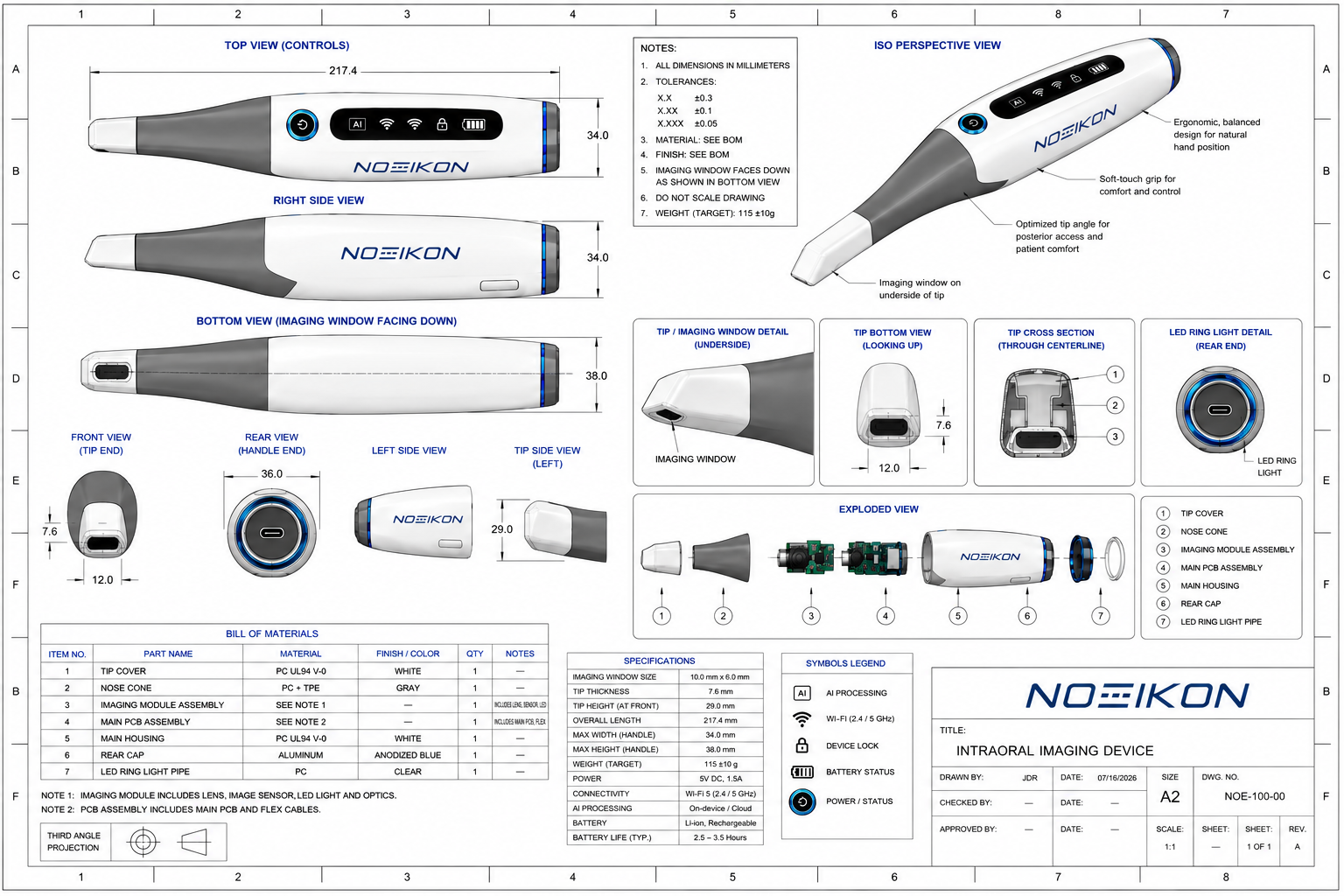
Overall Form Factor
246.0 × 34.0 × 38.0 mm · 240g (±10g) · pencil-grip ergonomics · Noeikon · Noeikon brand identity on body
Top / Side / Bottom / Rear / Tip
Full orthographic projection · 34.0mm width · 38.0mm height · front tip detail shows optical array layout
Internal Subsystem Layout
Optical path · onboard NPU/core compute · PUF/crypto module · power management · comms · thermal spreader · sterilizable housing
17-Part Assembly
Sterilizable tip shroud (PEEK) · optical window (sapphire) · imaging/illumination module · NPU compute module · PUF/crypto · thermal spreader · power PCB · comms · rear housing · side grips · USB-C · status LED
9-Subsystem Architecture
Optical array → ISP → NPU → CPU → RAM · PUF + secure element + crypto engine · trained dental AI model · FHIR generator · Wi-Fi 6 · BT 5.2 · USB-C Hi-Speed
Tip · Ergonomics · Charging · Sterilization
18.0mm tip width · 4× white + 4× NIR LEDs · RGB sensor · 240g balanced CG · USB-C + status LED · IPX7 seal · PEEK autoclave 134°C/3 bar/500 cycles · ISO 10993 biocompatible
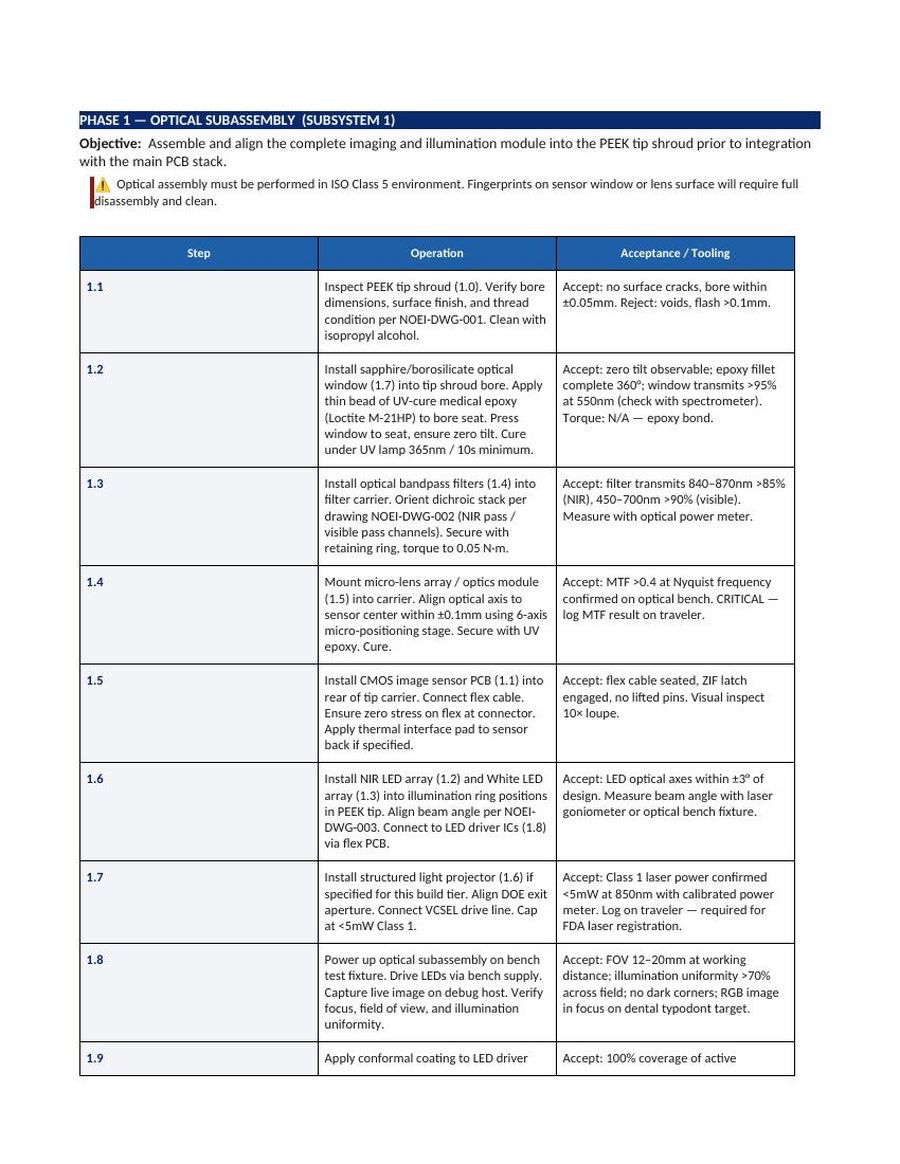
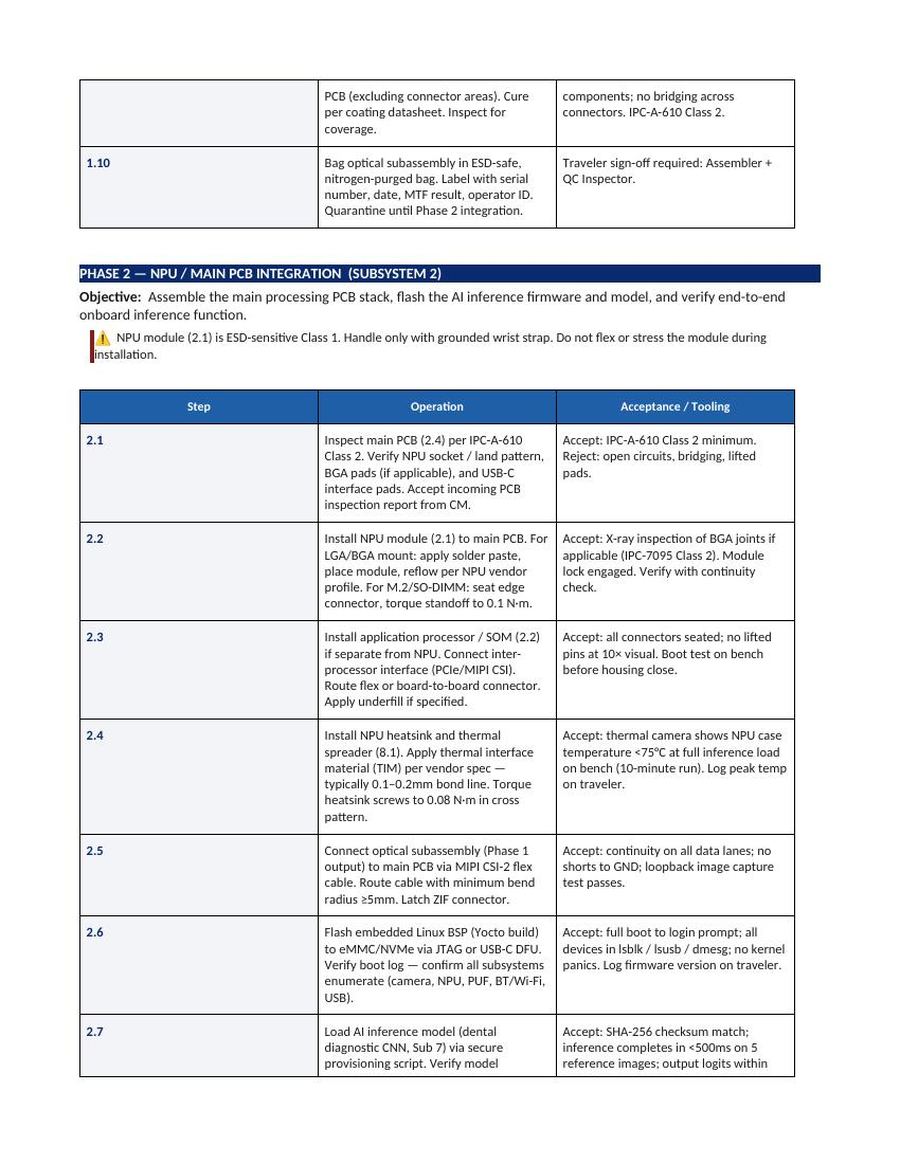
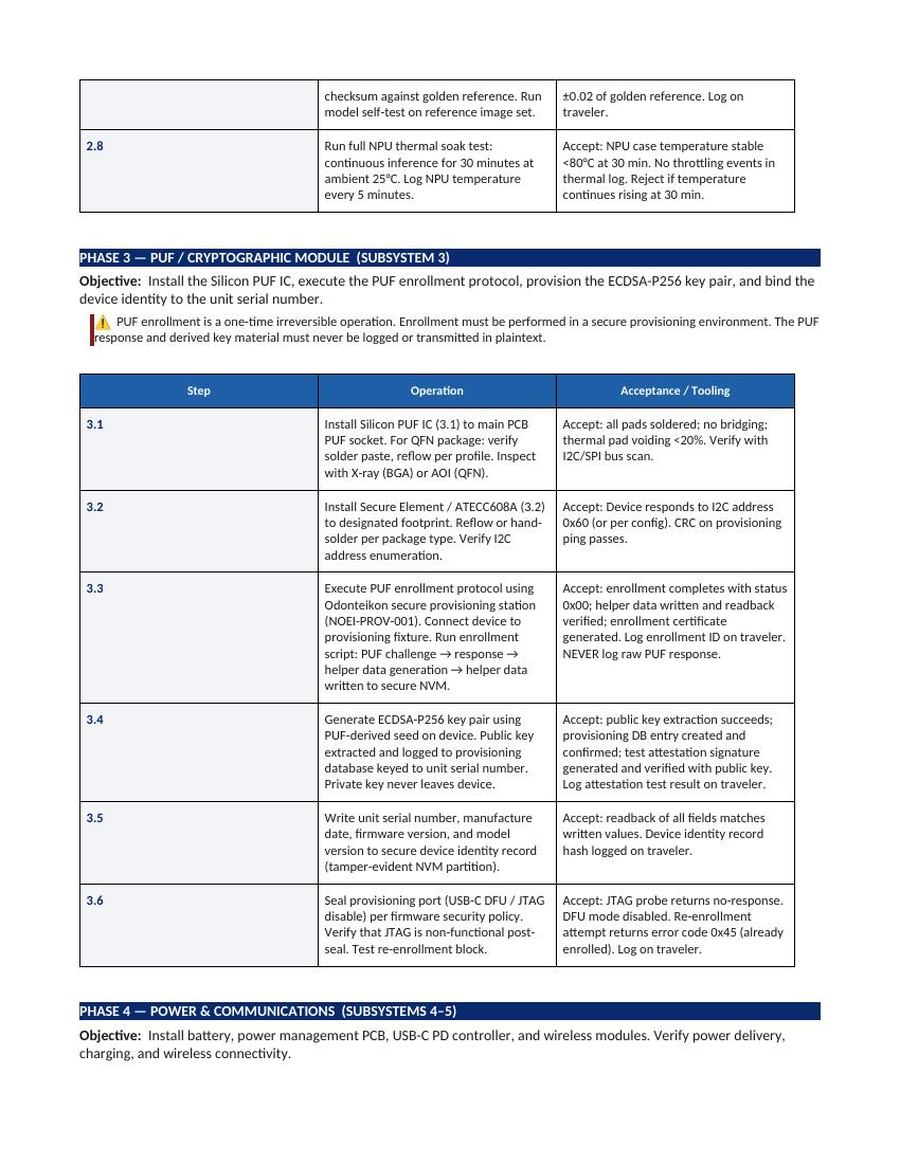
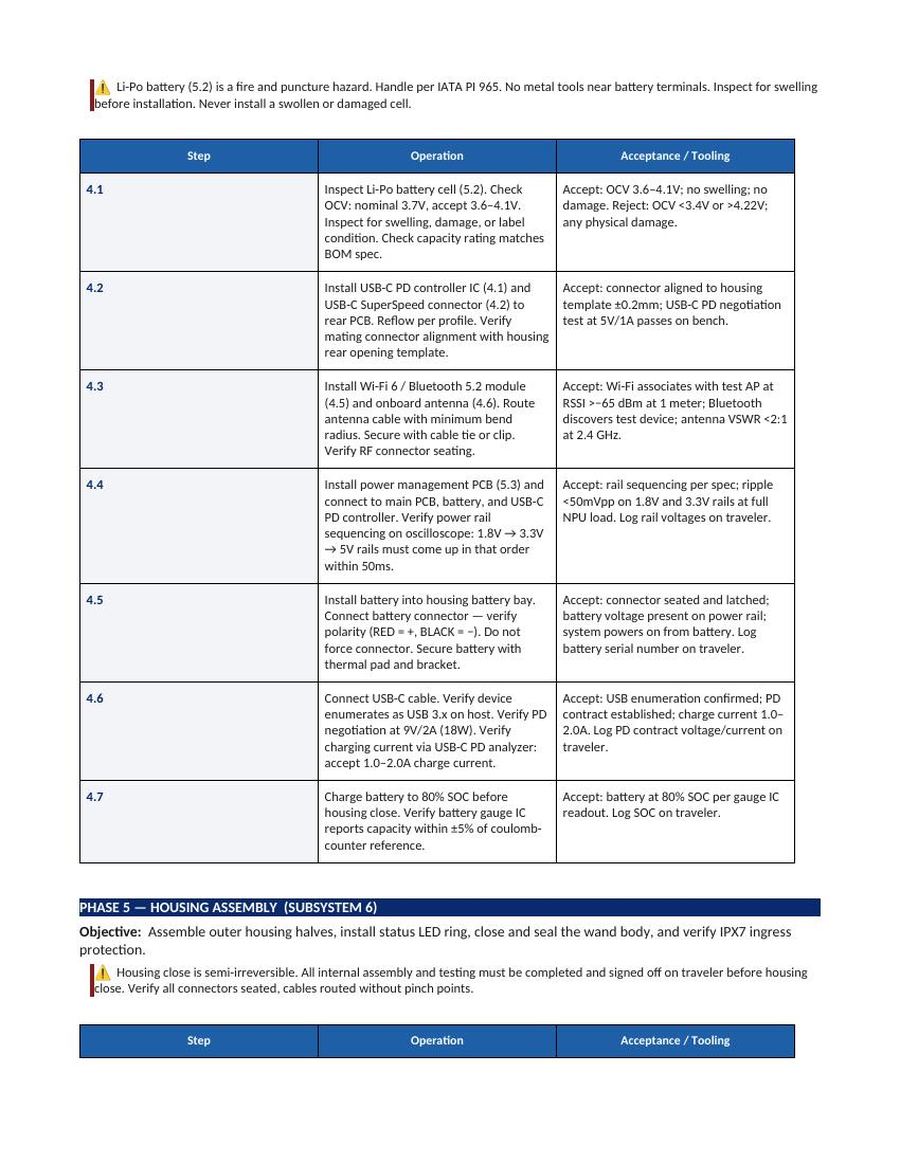
Assembly Operations Manual
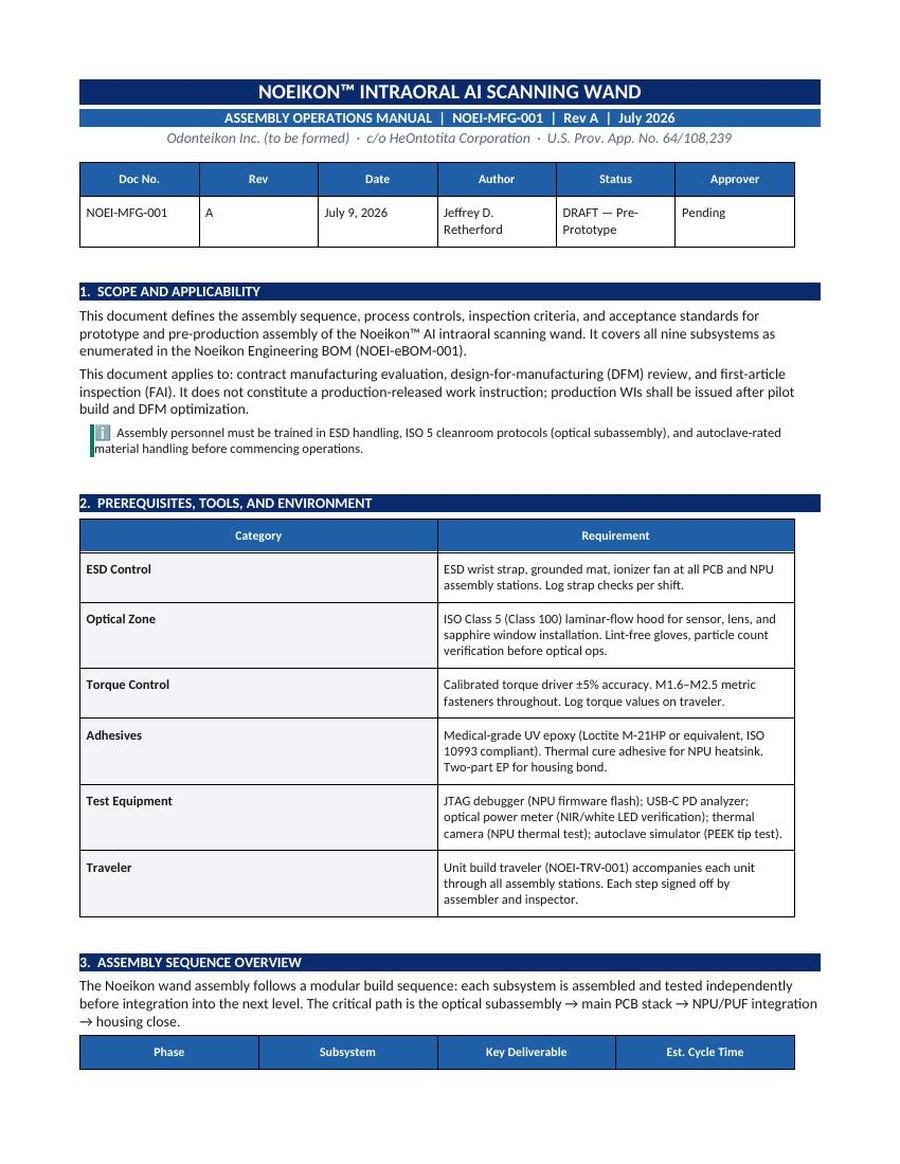
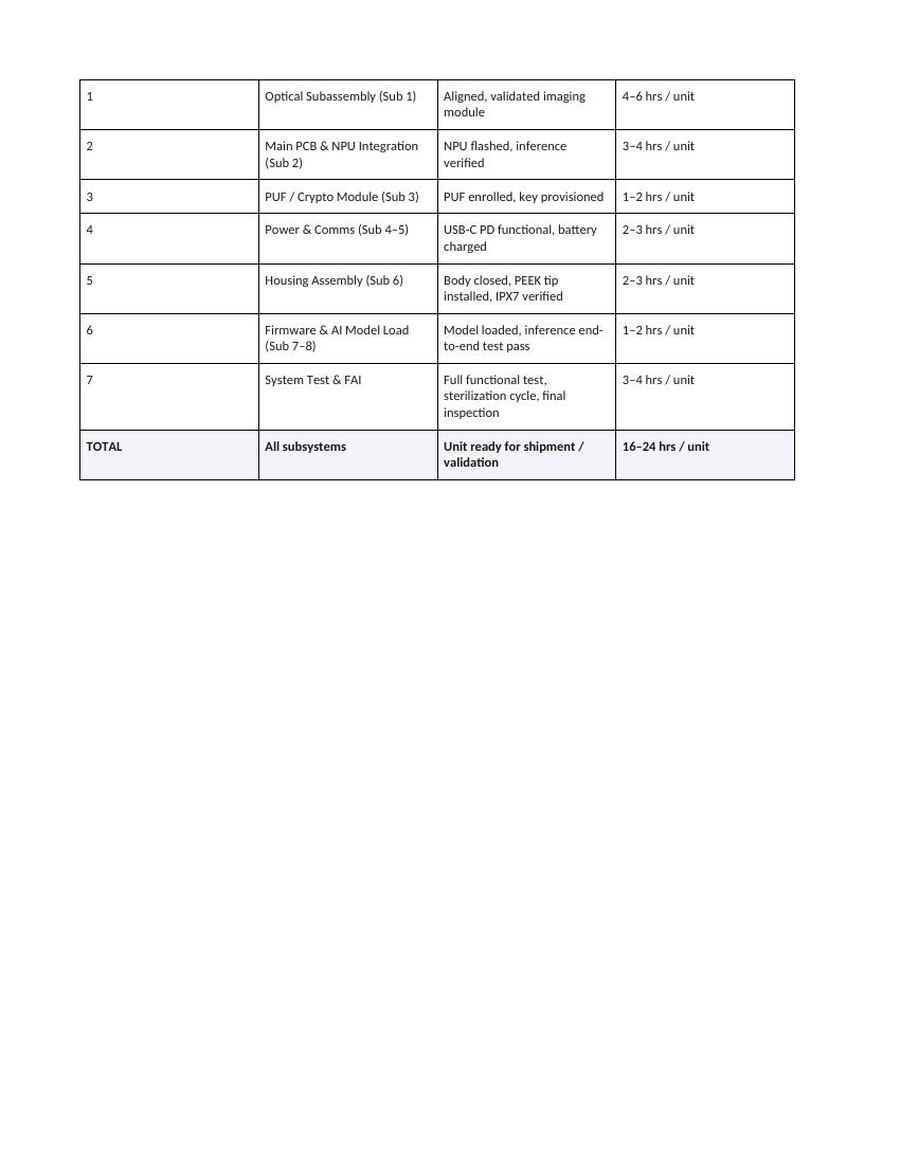
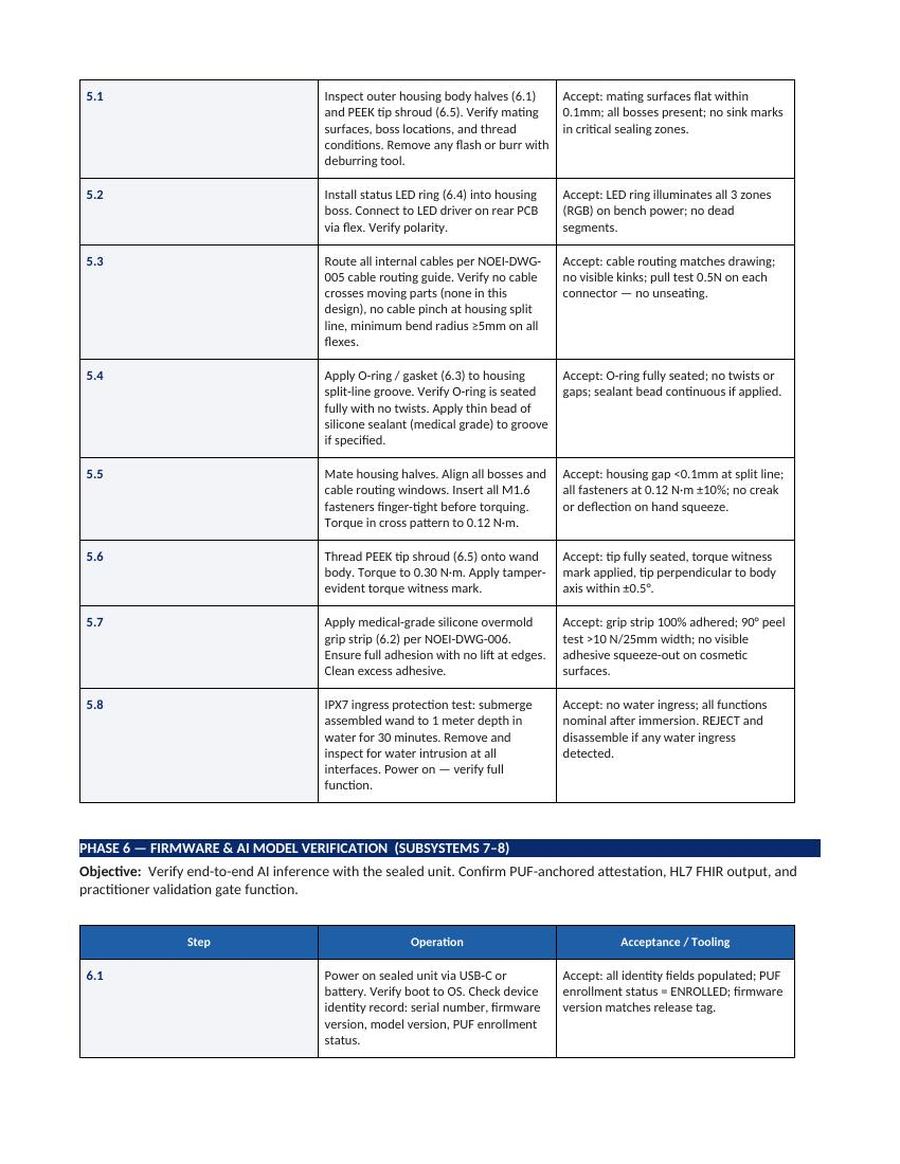
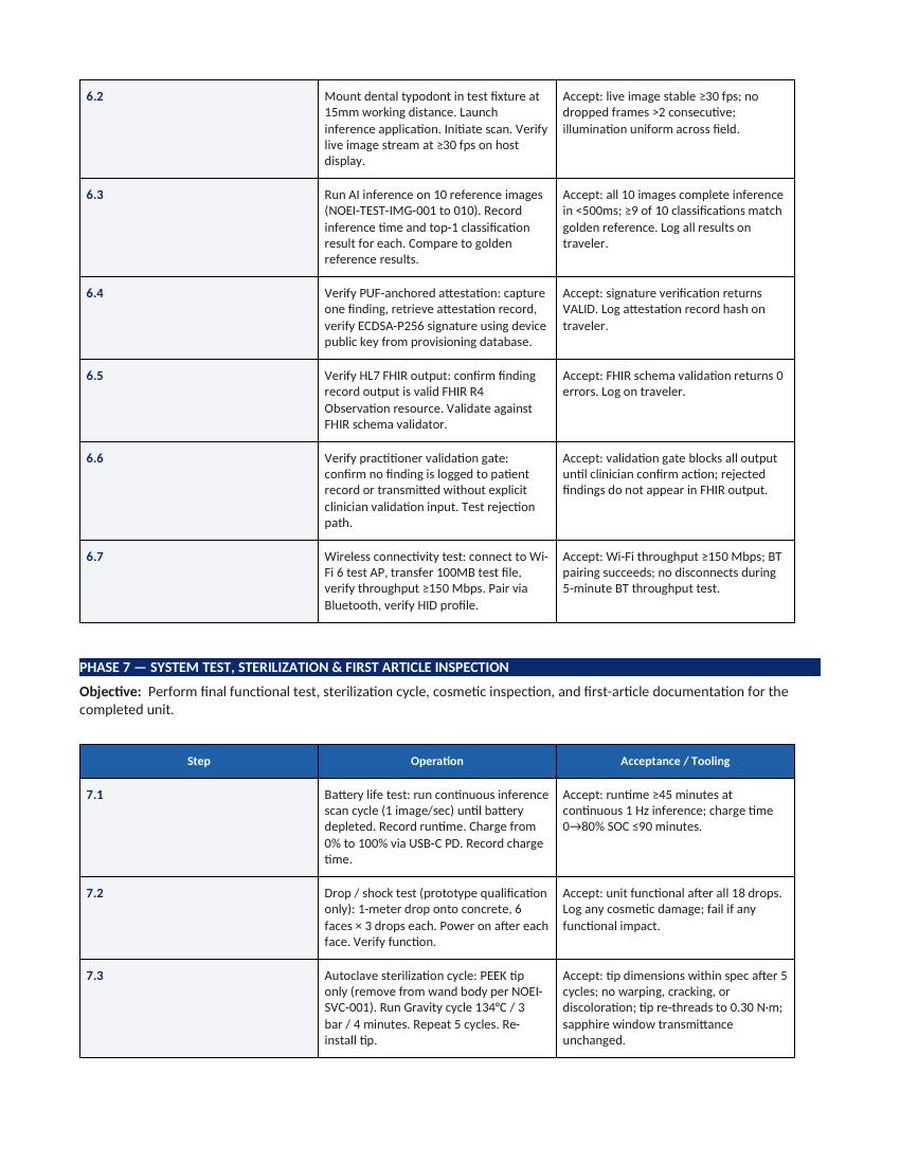
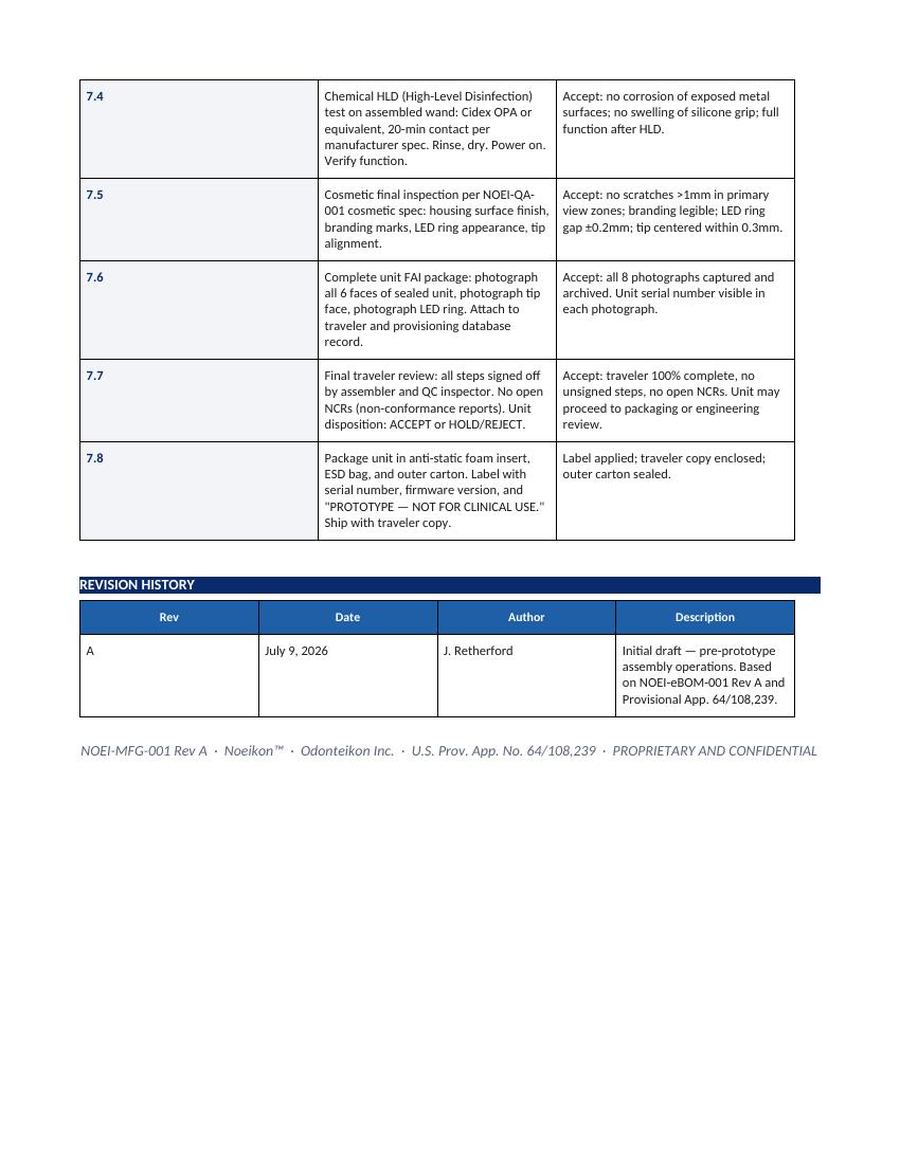
NOEI-MFG-001 Rev A — 7-phase, 56-step assembly sequence for the Noeikon™ intraoral AI wand prototype and pre-production builds. Covers optical subassembly, NPU/PCB integration, PUF enrollment, power systems, housing close, firmware load, and first-article inspection.

See the onboard AI
work in real time.
The only intraoral scanner with diagnostic AI in the handpiece — simulated live. From NPU inference stream to PUF-anchored attestation, all four modules run in your browser.
 Proof of Concept
READY
Intraoral Map
Awaiting scanAI Image Analysis
Claude Vision · Onboard SimulationUpload a dental photograph or X-ray. The Noeikon onboard AI will analyze it and return structured clinical findings — simulating what the embedded NPU produces at the point of acquisition.
JPG, PNG, WEBP · X-ray, intraoral photo, or periapical
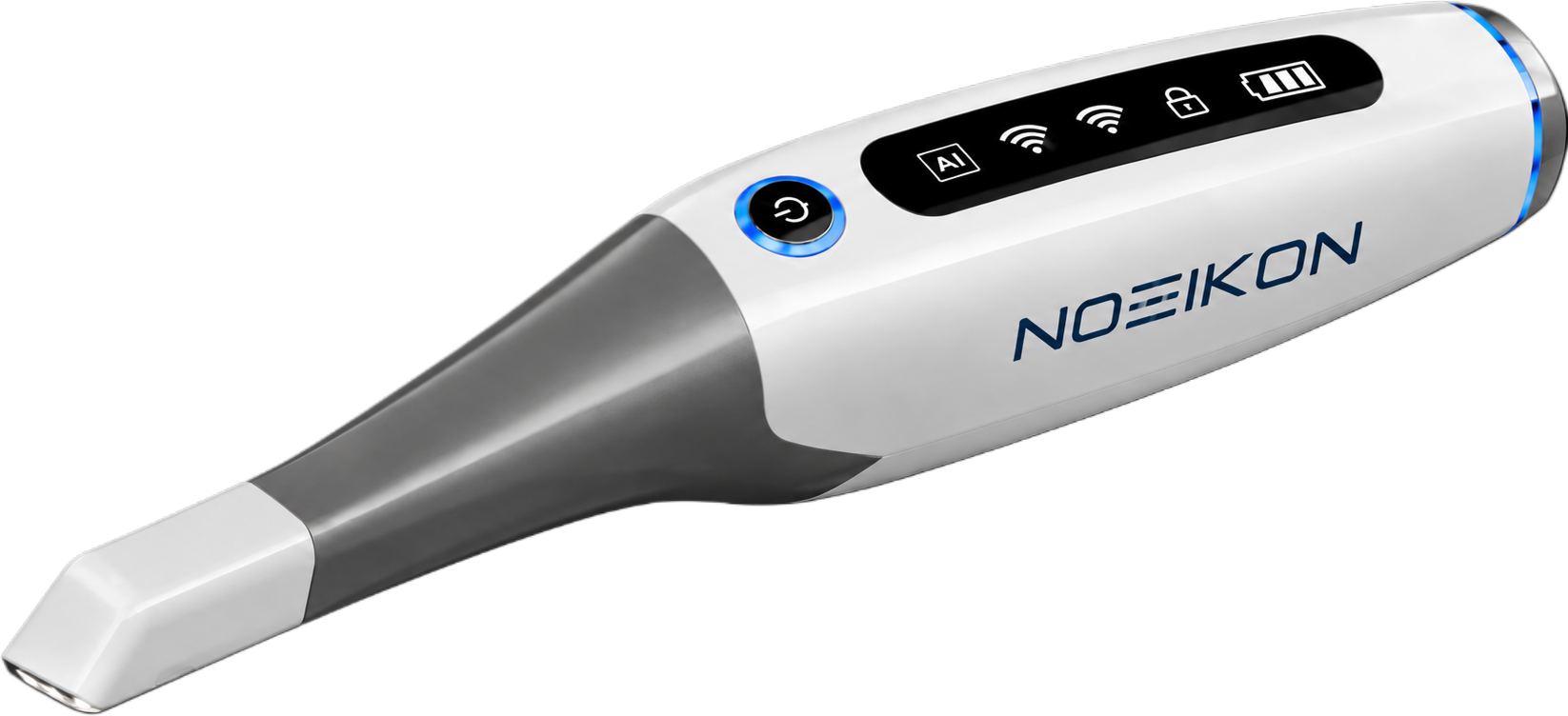
Product Render
NOEIKON™ · Onboard AI IOS Device · App. 64/108,239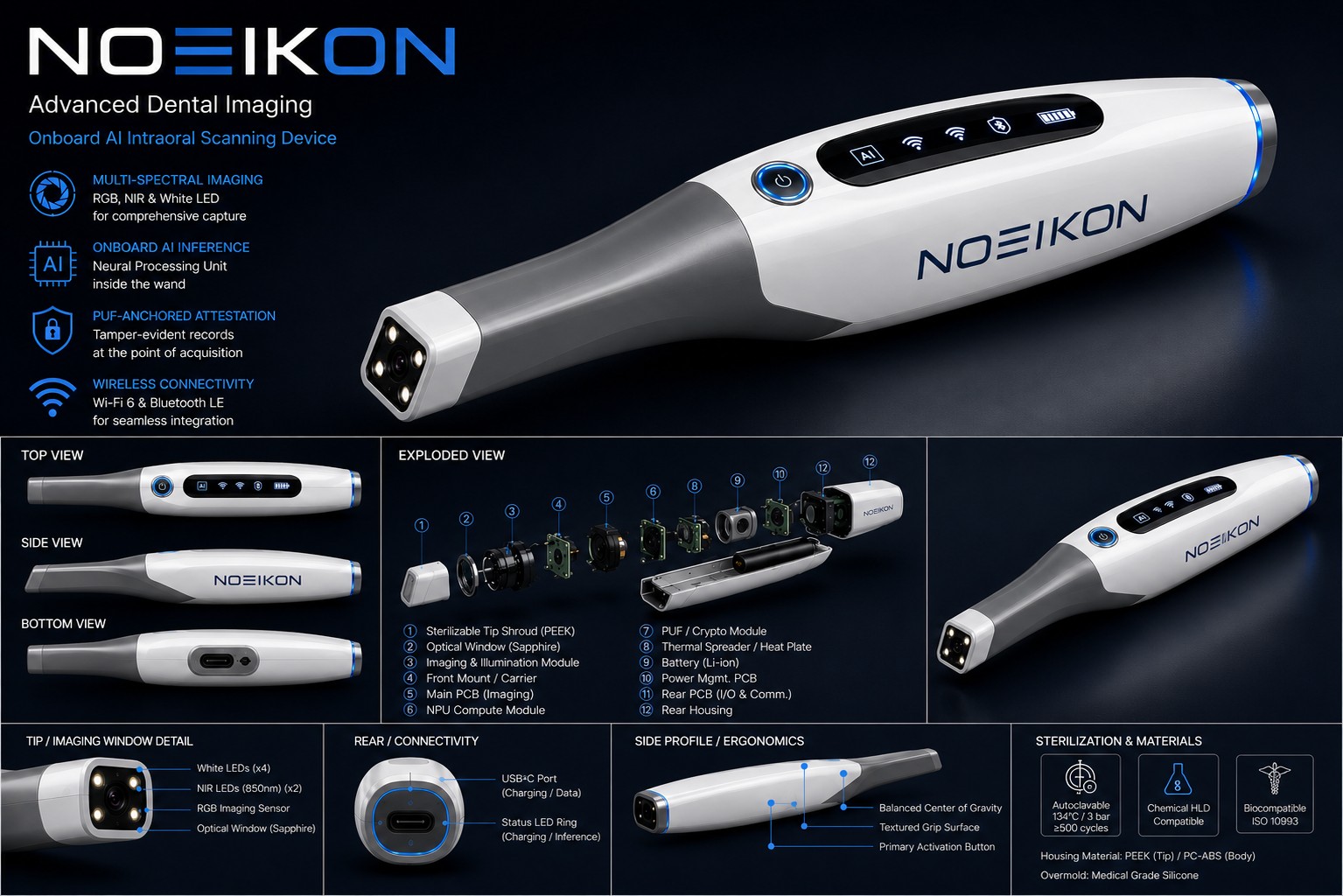
4× White LEDs + 2× NIR LEDs (850nm) + RGB sensor + optical window (sapphire)
The only diagnostic AI that runs inside the wand — no cloud, no workstation, no latency
Tamper-evident ECDSA-P256 signed finding records at point of acquisition
Balanced CG · textured grip surface · primary activation button · status LED ring
PEEK tip shroud · sapphire window · imaging module · NPU compute · PUF/crypto · thermal spreader · battery · power PCB · comms PCB · rear housing
Autoclave 134°C/3 bar/≥500 cycles · Chemical HLD compatible · ISO 10993 biocompatible · Medical grade silicone overmold
System Drawings
NOEI-001-PROV-DRW-001 · REV A · Sheet 1 of 3
246 × 34 × 38 mm · 240g
Full orthographic projection · pencil-grip form factor · front tip optical array detail
Internal Subsystem Layout
Optical path · NPU/compute · PUF/crypto · power · comms · thermal spreader · housing
17-Part Assembly
PEEK tip shroud · sapphire window · imaging module · NPU compute · PUF/crypto · thermal · power PCB · comms · grips · USB-C · status LED
9-Subsystem Architecture
RGB+NIR sensor → ISP → NPU → CPU → RAM · PUF + secure element · trained dental AI model · FHIR generator · Wi-Fi 6 · BT 5.2 · USB-C
18.0mm tip · 4× White + 4× NIR LEDs
RGB imaging sensor · optical window sensor · sapphire window · anti-reflection black coating
240g CG · IPX7 · PEEK · ISO 10993
Balanced CG · textured overmold · USB-C + status LED · autoclave 134°C/3 bar/500 cycles
Engineering BOM
NOEI-001-PROV · 71 Items · 9 Subsystems| # | Component | Est. Cost | Risk |
|---|